

Mosque carpet fitting in London comes down to three things: setting the prayer rows square to the qibla, planning every seam around those rows, and fitting the hall without stopping prayers. UTK Carpets and Flooring Ltd fits carpet in mosques, prayer halls and prayer rooms across London. To start, book a free site survey: we measure the hall, confirm the qibla line with your imam or committee, and give you a fixed quote.
The one thing no fitter can honestly give you is a price before seeing the hall. Cost and timing depend on the size of the hall, the carpet you choose and how much of the floor needs preparing, so every mosque job starts with a survey. The price we quote after that survey is the final price, with no extra charges on fitting day.
Whether you call it mosque or masjid carpet fitting, the work is part of our carpet fitting in London service. We fit to BS 5325:2021, the British Standard code of practice for installing textile floor coverings. This guide explains how a mosque carpet should be planned and fitted, so your committee knows what to ask any fitter, including us.
How are saff lines set square to the qibla?
Saff lines are the rows worshippers stand in for congregational prayer, and the qibla is the direction of the Kaaba in Mecca, which every row faces. For the rows to face the qibla squarely, they must run at right angles to it. Saff line carpet fitting is about getting that one angle right before a single cut is made.
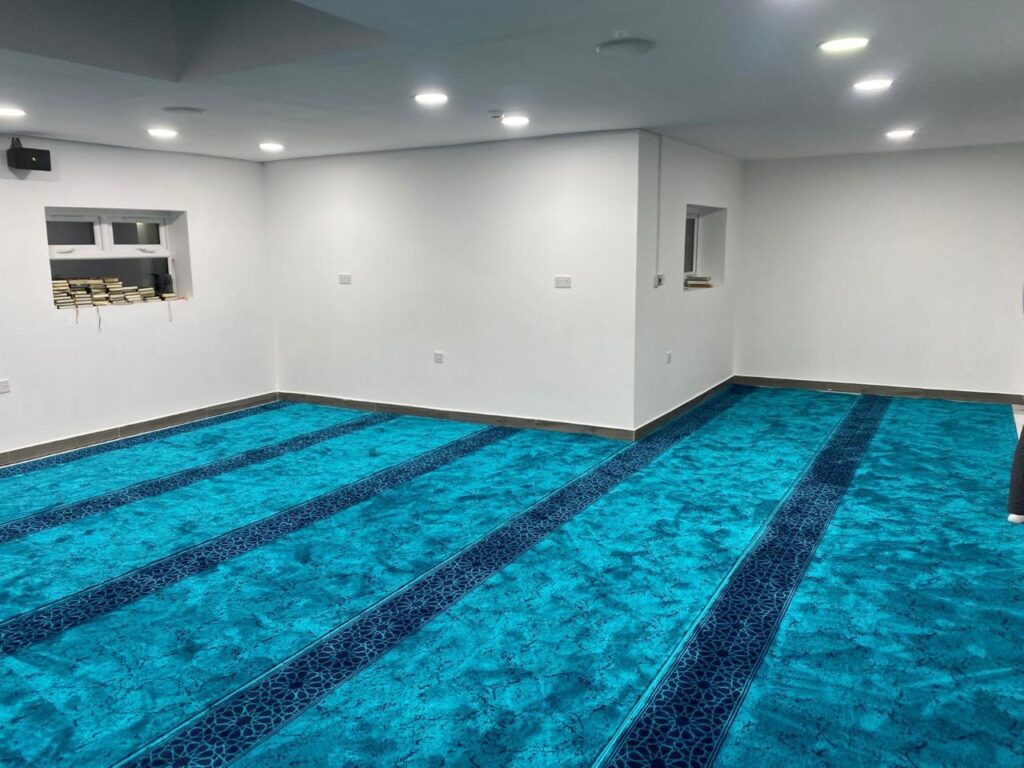
We don’t decide the qibla ourselves. Your imam or committee confirms it before we set anything out, and the mihrab, the niche in the qibla wall, is the fixed point the layout is centred on.
In a building that wasn’t built as a mosque, the qibla can run at an angle to the walls. When it does, the rows sit at an angle to the room too. That changes how the rolls are cut and how much carpet is trimmed away at the edges, which is why the angle has to be known at the survey, not on fitting day.
Once the qibla is confirmed, we mark one reference line on the floor square to it and check it before anything is fixed. Every row is then set from that line, not from the nearest wall.
Most crooked rows come from three mistakes:
- Rows lined up with a wall instead of the qibla.
- Small errors that add up across a wide hall, so the back rows drift.
- Seams placed without a plan, so the row pattern doesn’t line up across the join.
How do you measure a prayer hall and plan the layout?
We measure everything the carpet has to meet: the full hall, alcoves, pillars, doorways, the mihrab recess and any steps or changes in floor level. From those measurements we draw a layout showing where each roll runs, where the seams fall and where each row lands. You see that drawing before any carpet is ordered.
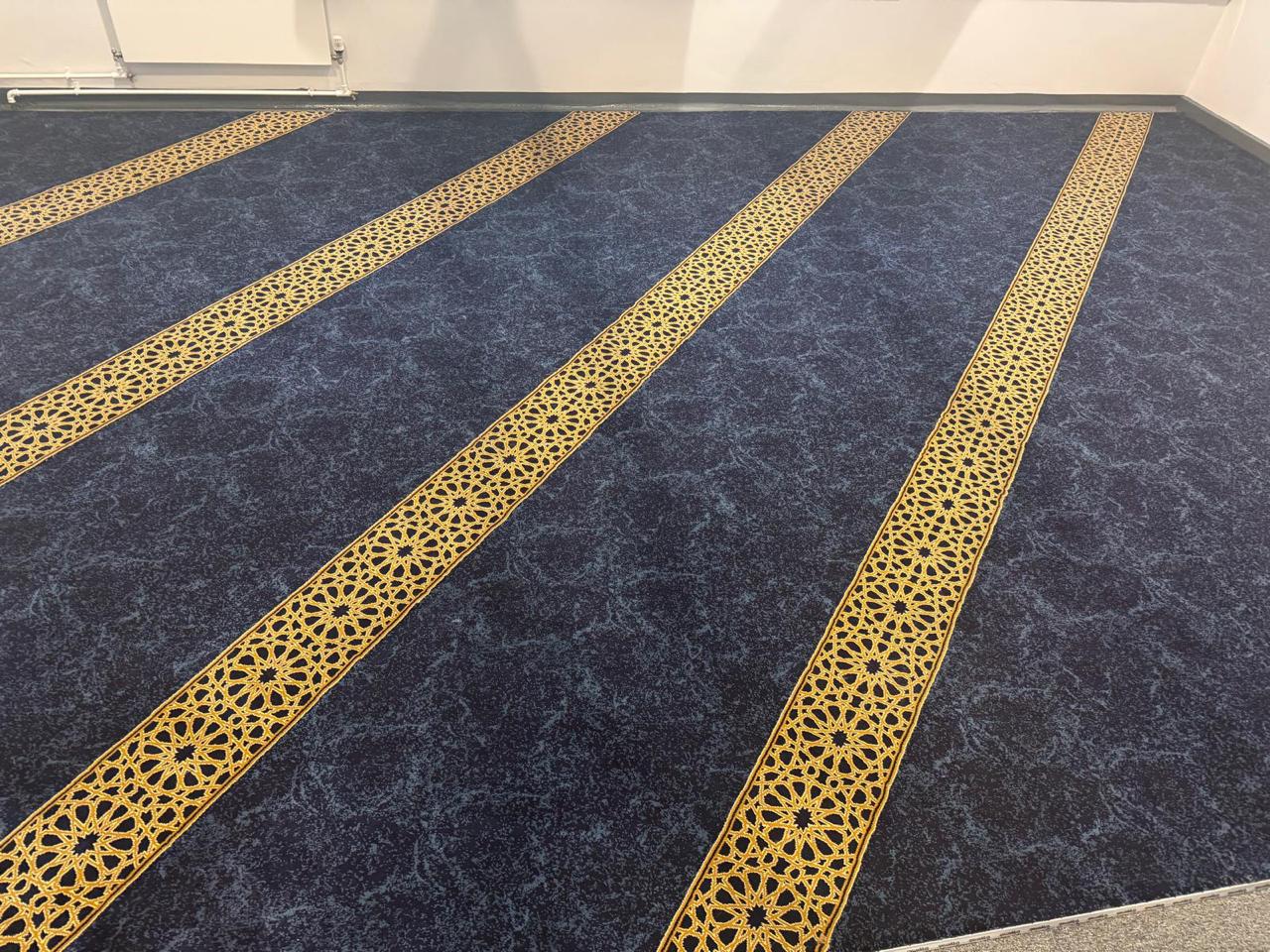
Saff carpet comes with its rows already woven or printed at a fixed spacing, so the hall has to be planned around that spacing. The first row is set from the qibla wall and the rest follow at the carpet’s own spacing, which decides how many full rows fit. Rolls are then cut and matched so the row pattern continues across every seam.
All the rolls for one hall should come from the same dye batch, the production run that fixes the colour. Rolls from different batches can differ slightly in shade, and the difference shows across a large, open floor.
If your committee wants a rough budget before the survey, send us these:
- The length and width of the prayer hall, and of any other areas to carpet
- The position of the mihrab, pillars and doorways, even as a hand sketch
- Photos of the current floor, including a corner where the old carpet lifts
- The carpet range or supplier, if you’ve already chosen one
The free site survey then checks all of it on site, including the qibla angle.
Which carpet suits a mosque: wool, acrylic or something else?
Wool and acrylic can both work in a prayer hall. The right one depends on the exact range, your budget and how heavily the hall is used, not on the fibre name alone. Wool is a natural fibre and acrylic is synthetic, and some mosque carpet suppliers also offer nylon ranges.
Ranges of the same fibre vary a lot in weight, construction and price. So ask the supplier for the specification sheet of a wool option and an acrylic option within your budget, and compare them line by line:
| What to compare | Why it matters in a prayer hall | Where to find it |
|---|---|---|
| Use or wear class | The same spots take daily foot traffic, kneeling and prostration | Manufacturer’s specification sheet |
| Pile height and density | Comfort during prostration, and how flat the rows stay | Specification sheet and a sample |
| Fire classification | A certificate to keep with the mosque’s fire safety records | Manufacturer’s fire certificate for that exact range |
| Cleaning guidance | Spills and grit near entrances and wudu areas | Manufacturer’s care guide |
| Row design and spacing | The rows have to suit your hall and congregation | Supplier’s design options |
| Price per m² | Usually the biggest single cost of the job | Supplier’s quote |
Saff line designs, colours and borders around the mihrab are chosen with the carpet supplier or manufacturer. If a range is sold as antibacterial or fire-rated, ask to see that claim on the manufacturer’s own documents before you rely on it.
How is carpet fitted in a large prayer hall?
Prayer hall carpet fitting follows the same order every time, and each step depends on the one before it:
- Take up the old carpet and gripper, and remove them from site. This is where a mosque carpet replacement starts.
- Prepare the subfloor: fix loose boards, level dips and check concrete for moisture. Our subfloor preparation work covers screeding, the levelling compound that gives a flat base.
- Fit gripper rods around the edges. These are wooden strips with angled pins that grip the carpet’s edge and hold it under tension.
- Lay the underlay. In a large hall an acoustic underlay can reduce footfall noise, and our guide to choosing underlay explains the options.
- Lay the carpet from the reference line, matching the rows across each roll.
- Join the seams with hot-melt seaming, a heat-activated tape under the join that bonds the two edges together.
- Stretch the carpet onto the gripper with a power stretcher braced against the opposite wall. It is the same commercial equipment we use for carpet re-stretching, and it pulls the carpet tight across the full width, which a hand-held knee kicker can’t do across a hall this size.
- Trim the edges and finish at doorways with door bars, easing any doors that the new floor height catches.
Every step follows BS 5325:2021. Carpet that isn’t stretched properly is what usually comes back as ripples, and an uneven subfloor shows through even a heavy carpet.
Can you fit the carpet without closing the mosque?
Usually, yes, by planning the work around your prayer timetable. Share the five daily prayer times and Friday Jumu’ah with us, and we plan each stage so the hall is clear when it’s needed. Evening and weekend slots are available.
On a large hall the work can be split into phases, so one part of the hall is fitted while another stays in use. Taking up the old carpet is the dustiest stage, so it is worth timing for when the hall can be closed for longest.
If you want the new carpet down before Ramadan, book early. Ramadan’s dates move each year and depend on the sighting of the moon, so confirm your mosque’s expected dates and allow time for the survey, ordering the carpet and fitting. The same applies to Eid, when the hall is at its busiest.
What about women’s areas, galleries, stairs and prayer rooms?
Every prayer space faces the qibla, so a women’s prayer area, whether it is a separate room or a gallery above the main hall, is set out from the same direction as the main hall. Planning all the areas together at the survey keeps the rows consistent and lets the carpet for every area come from one order.
Gallery stairs take more care than the floor. Each tread and riser is covered and fixed separately, and winding stairs need a paper template for every winder tread. Our stair carpet runners page shows how we template and finish stairs.
Prayer room carpet fitting, in a musalla at an office, school, university or hospital, follows the same rules on a smaller scale. The rows still have to face the qibla, and the work usually has to fit around the building’s working hours.
Islamic centre carpet fitting often goes beyond the prayer hall, into corridors, classrooms and community rooms. Those spaces may suit a harder-wearing floor than the prayer hall carpet. whether UTK fits carpet tiles or LVT in these areas] Wudu areas, where people wash before prayer, need flooring made for water, which is a different job from carpet.
What affects the cost of carpeting a mosque?
The cost of carpeting a mosque comes from the area, the carpet you choose, the state of the floor underneath and how the work has to be scheduled. There is no fixed price per mosque, so this table shows what moves the price and what to have ready for an accurate quote:
| Factor | Why it changes the price | What to have ready for the quote |
|---|---|---|
| Hall area in m² | Carpet and labour scale with the area; rows set at an angle to the walls mean more trimming at the edges | Length and width of each area |
| Carpet type and grade | Usually the largest single cost | The range or supplier, if already chosen |
| Saff line or custom design | Matching rows and borders across rolls can mean more waste | Your design preference |
| Underlay | Acoustic or thicker underlay costs more than standard | Whether noise is a problem in the hall |
| Subfloor condition | Levelling, board repairs or moisture treatment add labour and materials | Photos of the floor where the old carpet lifts |
| Uplift and disposal | Taking up and removing old carpet and gripper adds time | Whether the old carpet is staying or going |
| Out-of-hours or phased work | Work split across evenings, weekends or phases takes longer to deliver | Your prayer timetable and any dates the hall can’t close |
| Galleries and stairs | Stairs are fitted tread by tread | Number of flights and treads |
ULEZ charges, Congestion Charge fees and parking costs are included in our quotes, so they don’t appear as extras. Our published carpet fitting prices give a guide for standard rooms; mosque jobs are priced after the free survey.
What should a mosque committee ask a carpet fitter?
These questions separate a fitter who has planned a prayer hall from one who will treat it like any large room. Ask them of every fitter you get a quote from, us included:
- Have you fitted mosques or other large halls, and can we see the work? You can browse photos of our work.
- Will you survey the hall and draw the layout before quoting? A price given over the phone for a whole prayer hall can’t allow for the qibla angle, the subfloor or the row spacing. The question that exposes it: “How did you allow for the angle of our qibla?”
- How will you set the first row, and how will you check it before fixing anything?
- Where will the seams fall, and how will the rows line up across them?
- Do you fit to BS 5325:2021, the British Standard code of practice for installing textile floor coverings?
- Are you insured for this work, and can we see the certificate?
- Is your workmanship guaranteed? Ours is: if a problem comes from our fitting, our team will return and put it right at no additional cost.
- Is the quote fixed, and how long does it stay valid while the committee decides?
- Can you work around our prayer times, and finish before Ramadan if we need it?
- Can we have the manufacturer’s fire certificate for the carpet we’re buying?
How do you look after a mosque carpet once it’s fitted?
A mosque carpet lasts longest when grit is kept out and small problems are fixed early. Vacuum regularly, and put entrance mats where shoes come off, because grit carried in from outside wears the pile fastest near the doors. Blot water from wudu areas or spills straight away, before it soaks through to the underlay.
In a large hall, a carpet can loosen over time and start to ripple. Mosque carpet re-stretching with a power stretcher pulls it tight again, and it is worth doing early, before a ripple becomes a trip hazard during a full congregation.
Damage doesn’t usually mean replacing the whole hall. Holes, worn patches and damaged seams can often be fixed with carpet repairs, using a matching piece from an offcut or a hidden area. Burns from candles or coals can be cut out and patched the same way; our carpet burn repairs page explains how, and a single burn takes 30 to 60 minutes to repair. Keep the offcuts from the original fitting for exactly this reason.
We don’t offer carpet cleaning, so for deep cleaning use a specialist cleaner and follow the manufacturer’s care guide.
The short version
A mosque carpet is fitted from one reference line set square to the qibla, which your imam or committee confirms, with every seam planned so the rows line up across it. The hall is surveyed and drawn before any carpet is ordered, the rolls come from one dye batch, and the carpet is power-stretched onto gripper rods to BS 5325:2021. The work can be planned around prayer times, and the price quoted after the free survey is the final price.
Frequently asked questions
Do you supply the carpet, or fit carpet we buy?
Yes, we offer a complete supply and installation service. Whether you source the material yourself or have us supply custom-manufactured mosque and masjid carpets, our expert team verifies the precise row spacing, saff alignment, and dye batch against your architectural layout drawings before any fitting begins.
How long does it take to carpet a prayer hall?
It depends on the size of the hall and how much subfloor preparation it needs. We agree the schedule with you around your prayer times.
Do we need to clear the hall before fitting?
Yes. Bookcases, Qur’an stands and other loose items need to be moved out before the old carpet comes up, and fixed items such as a built-in min bar are fitted around. but we can also help if we are present it the time.
Can carpet go over underfloor heating?
Yes, if the carpet and underlay together stay within the heating’s limit. Carpet maker Cormar gives 2.5 tog combined as a realistic maximum and recommends underlay below 1.3 tog, so check your heating system’s own limit too.
Can new carpet be joined to the carpet in an existing extension?
Only if the same range is still made, and even then a new dye batch can differ slightly in shade. Where it won’t match, a clean break at a doorway usually looks better than a visible join.
Can a prayer hall use carpet tiles instead of rolls?
Carpet tiles can be fitted in prayer rooms and halls, fixed with double-stick adhesive in the same way we fit them in offices, showrooms and shops. Whether a tile range with saff rows suits your hall is a question for the supplier, and we check it at the survey.
Can you carpet a new-build mosque?
Yes, once the new screed has dried enough to take carpet. We test the subfloor for moisture before fitting, because carpet laid over a damp floor can fail.
Do you work outside East London?
Yes. We fit carpet across London from our base on Lodge Avenue in Dagenham.
Book a free site survey
UTK Carpets and Flooring Ltd (company number 17182359, registered at Companies House) fits carpet in mosques, prayer halls and prayer rooms across London from Lodge Avenue in Dagenham. If you’re looking for mosque carpet fitters in East London or anywhere in London, call 07578196079 to book a free site survey, or read more about UTK.
Checked and updated on 10 October 2026. Confirm fire classifications with the carpet manufacturer, and the qibla and Ramadan dates with your mosque’s imam or committee.